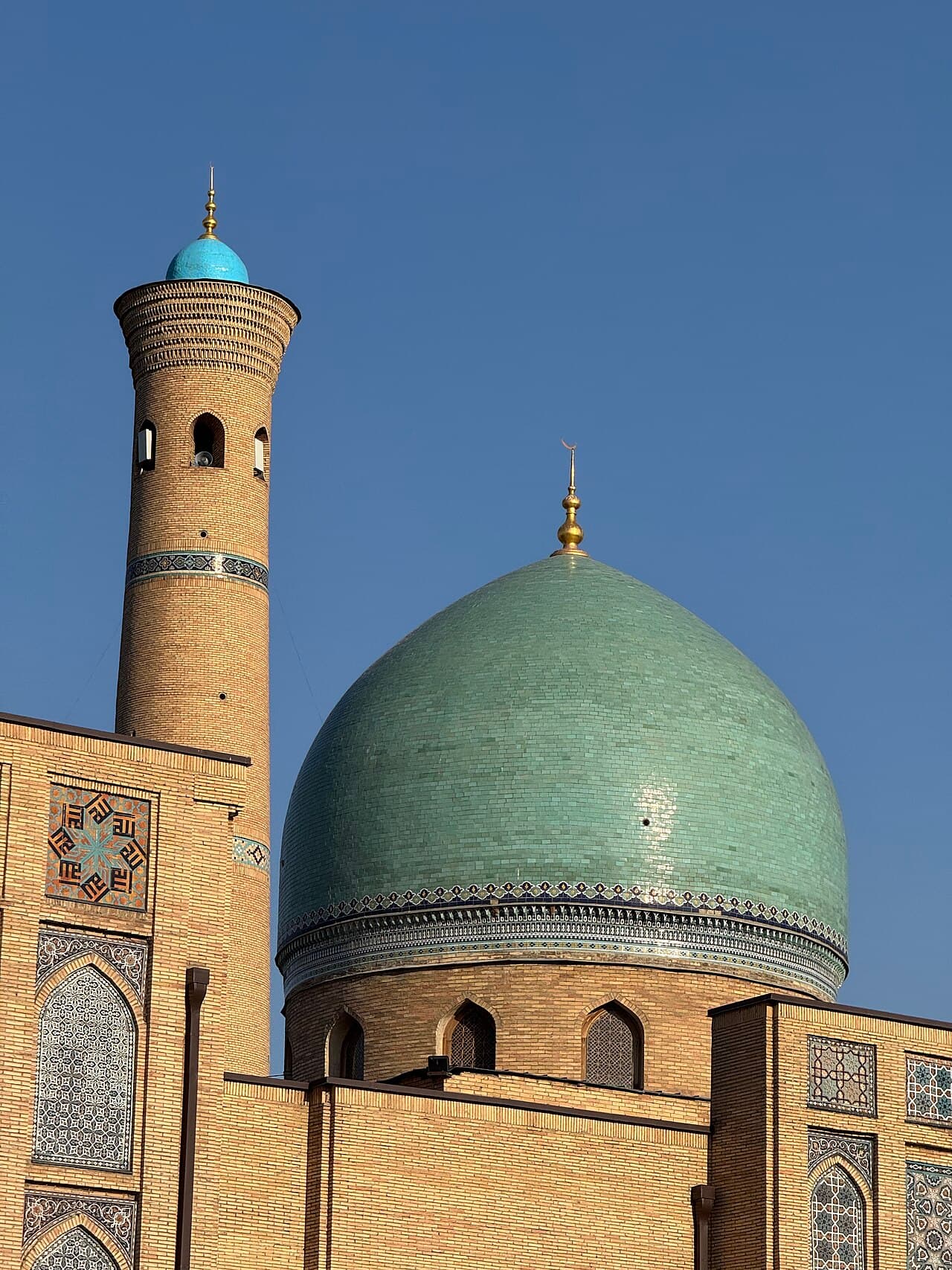
The full sweep of Uzbekistan in twelve days, taken from west to east so that the country opens up gradually: the capital first, then the Savitsky collection in Nukus, the clay fortresses of ancient Khorezm, the walled town of Khiva, the trade domes of Bukhara, a yurt camp in the Kyzylkum and finally the great Timurid…
The full sweep of Uzbekistan in twelve days, taken from west to east so that the country opens up gradually: the capital first, then the Savitsky collection in Nukus, the clay fortresses of ancient Khorezm, the walled town of Khiva, the trade domes of Bukhara, a yurt camp in the Kyzylkum and finally the great Timurid ensembles of Samarkand.
It is a route with real variety. You fly to Nukus for a museum that has no business being where it is, cross into the desert for Chilpyk, Toprak-Kala and Ayaz-Kala, drive the long road between Khiva and Bukhara that the caravans once used, ride a camel out towards Aydarkul Lake and hear an akin sing by the fire, then finish among the tiled facades of the Registan.
Fully escorted throughout, with hand-picked hotels, an English-speaking guide, internal flights, the Afrosiyob high-speed train and all ground transport included.
Tour highlights
Savitsky Museum, Nukus
Ayaz-Kala and Toprak-Kala fortresses
Itchan Kala, Khiva
Kalyan Minaret and Ark Fortress, Bukhara
Yurt camp and Aydarkul Lake
Registan Square and Shakhi-Zinda
12 days
Day-by-day itinerary
Day 1Arrival in Tashkent
You are met at Tashkent International Airport and transferred to your hotel. After check-in your guide takes you through the capital, beginning at the Courage Monument, which marks the earthquake of 1966, and continuing into the old city for the Mausoleum of Kaffal Shashi and the Khast-Imam Complex. You then explore Chorsu Bazaar and a pottery gallery, ride the decorated Tashkent Metro into the modern centre, visit the State Museum of Applied Arts and finish at Amir Timur Square. Overnight in Tashkent.
Day 2Tashkent – Nukus
A morning transfer to the domestic terminal for the flight to Nukus, some 810 km and about an hour and forty minutes away in the far west of the country. On arrival you visit the Savitsky Karakalpakstan Art Museum, where Igor Savitsky assembled the world's second largest collection of Russian avant-garde painting, far from the censors, alongside Karakalpak applied art. A short drive around the centre takes in the statue of the poet Berdakh, the city hall and the drama theatre. Overnight in Nukus.
Day 3Nukus – ancient Khorezm – Khiva
Today you drive south towards Khiva, about 200 km, stopping among the archaeological monuments of ancient Khorezm on the way. You climb to Chilpyk, the ring-walled Zoroastrian dakhma above the Amu Darya, then continue to Toprak-Kala, capital of Khorezm in the third century AD, and to Ayaz-Kala, a group of Kushan-era fortresses on a desert hill with a very wide view. You reach Khiva in the late afternoon and check in beside the old walls. Overnight in Khiva.
Day 4Khiva
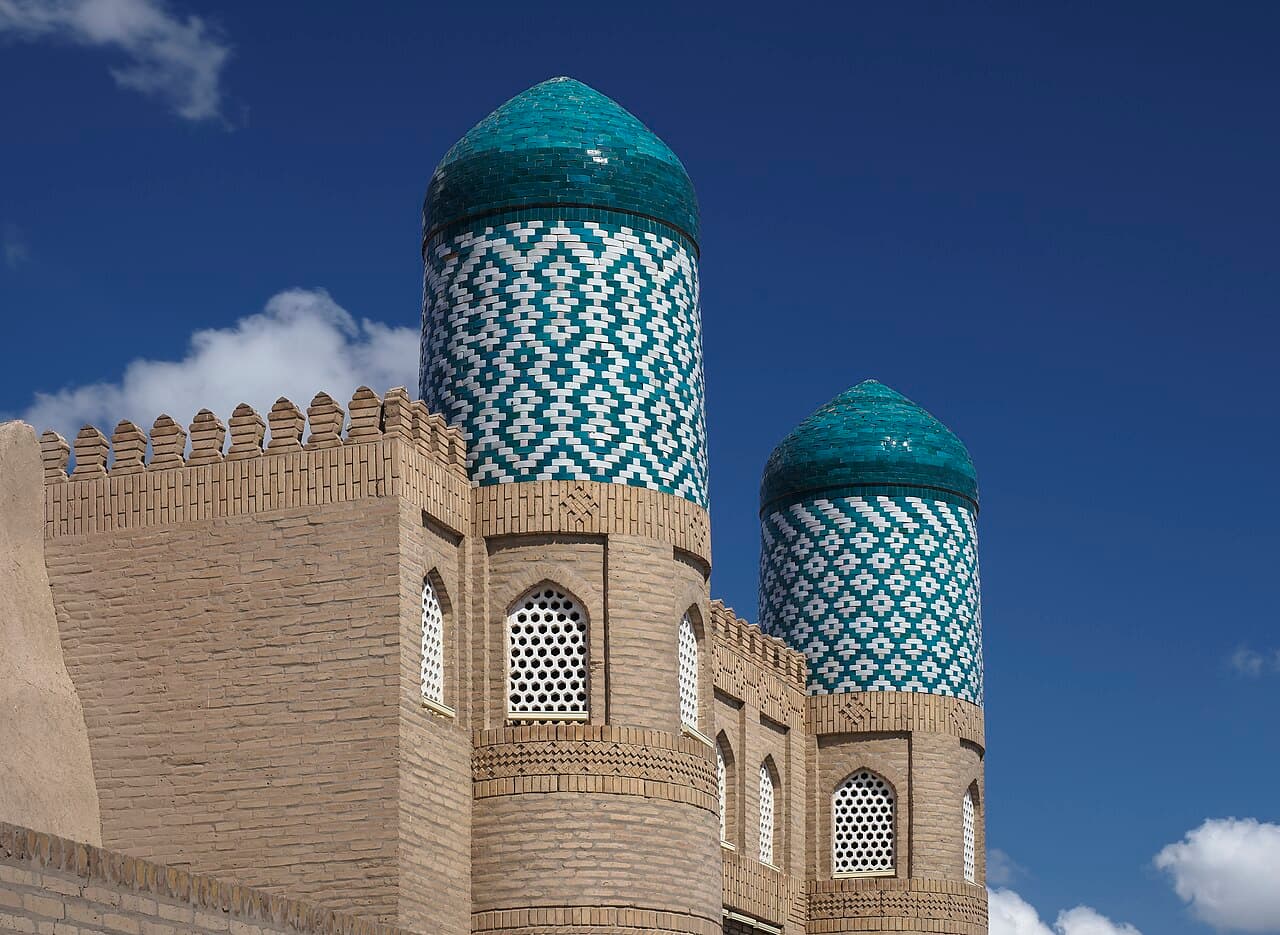
A full day on foot inside Itchan Kala, the walled inner town and a UNESCO World Heritage site that is still lived in. With your guide you visit the Kunya-Ark citadel, the Tash-Khovli Palace, the Mukhammad Aminkhan and Mukhammad Rahimkhan madrasahs, the stumpy turquoise Kalta-Minor, the Juma Mosque with its forest of carved wooden columns and the Mausoleum of Pakhlavan Makhmud. The afternoon is free for the workshops, the wood carvers and a walk on the walls at sunset.
Day 5Khiva – Bukhara
A long but memorable driving day: 480 km across the Kyzylkum Desert on the road that shadows the old caravan route between the two khanates, seven to eight hours with stops. You pause for views of the desert and the Amu Darya, and it is worth arranging a packed lunch the day before, as the roadside cafes are basic. You arrive in Bukhara in the late afternoon, check in and have the evening free around Lyabi-Khauz, where the plane trees and teahouses come to life after dark.
Day 6Bukhara
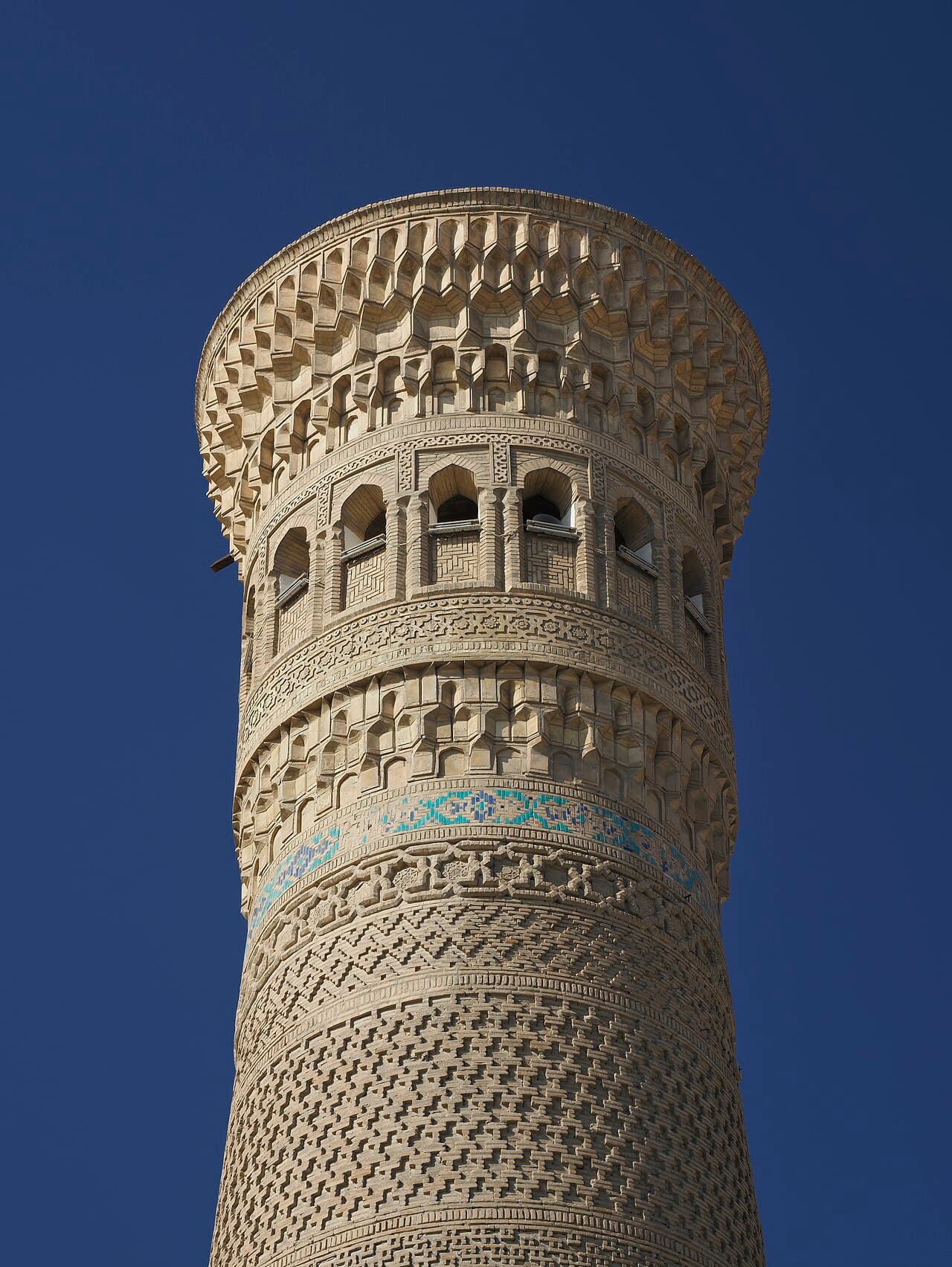
A walking day through the old city, which is compact enough to cover on foot. You start at the Lyabi-Khauz ensemble, then work through the Magoki-Attori Mosque, the four-turreted Chor-Minor Madrasah, the covered trade domes where the jewellers and hatters still work, and the great set piece of the Poi-Kalyan: the Kalyan Minaret, the Kalyan Mosque and the Miri-Arab Madrasah facing each other across the square. You also see the Ulugbek and Abdulazizkhan madrasahs. Overnight in Bukhara.
Day 7Bukhara
The second Bukhara day begins at the Ark Fortress, the citadel from which the emirs ruled, and the Bolo-Khauz Mosque opposite with its slender painted columns. You continue to the Chashma-Ayub mausoleum and the tenth-century Ismail Samani Mausoleum, whose woven brickwork is the oldest in the city. In the afternoon you drive out to Sitorai Mokhi-Khosa, the last emir's summer palace, and to the Mausoleum of Bakhouddin Naqshbandi, the most important Sufi shrine in Central Asia.
Day 8Bukhara – Gijduvan – Nurata – yurt camp
You leave Bukhara after breakfast and stop first at Gijduvan, where the Narzullaev family have been potters for generations, to see the workshop and the ceramics museum. The road then runs east into the Kyzylkum, with a halt at Nurata to see the holy spring and the mosque beside the remains of the fortress attributed to Alexander the Great. You reach the yurt camp in the afternoon, ride a camel into the dunes, and after dinner sit around the fire while a Kazakh akin sings.
Day 9Yurt camp – Aydarkul – Samarkand
You wake in the yurt and drive out to Aydarkul Lake, a startling sheet of water in the middle of the desert, with free time on the shore and a swim if the season allows. There is the option of reaching the lake by camel instead, or of a shorter ride to the village of Dungalak to bake non with a local family. In the afternoon you leave the camp for Samarkand, around 270 km and five hours, arriving in the evening.
Day 10Samarkand
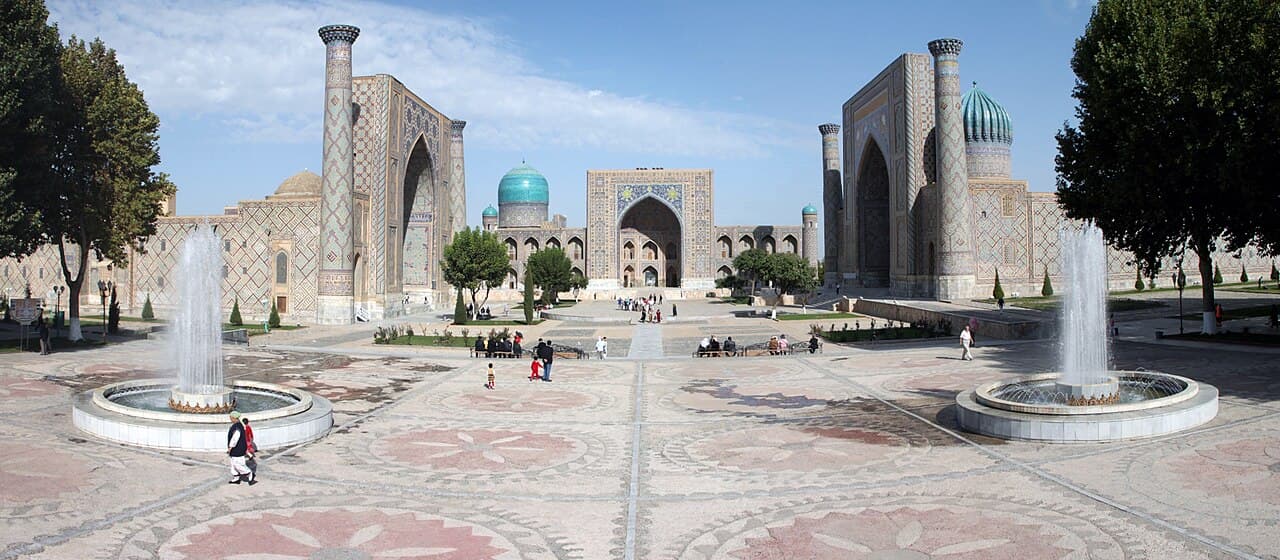
Your first full day in Samarkand takes in the city's greatest monuments. You begin at the Ulugbek Observatory, where the buried arc of the fifteenth-century sextant survives, continue to the tiled avenue of the Shakhi-Zinda Necropolis and the remains of the Bibi-Khanum Mosque, and walk through the souvenir alley to the Registan Square, flanked by the Ulugbek, Sher-Dor and Tillya-Kari madrasahs. The day ends at the Gur-Emir Mausoleum, the tomb of Timur himself.
Day 11Samarkand – Tashkent
After check-out you continue sightseeing with the Afrasiab Museum and the archaeological mound beside it, where the seventh-century ambassadors' murals were uncovered, and the Tomb of Saint Daniel with its long sarcophagus above the Siab stream. You then drive to Konigil village to watch mulberry bark being turned into Samarkand paper. In the late afternoon you transfer to the station for the Afrosiyob train to Tashkent and are met on arrival.
Day 12Tashkent – departure
Check-out from the hotel is at noon, with free time beforehand for any last shopping. Depending on your flight you might visit the Islamic Civilisation Centre, walk the shaded avenues near the Alisher Navoi Opera and Ballet Theatre or return to Chorsu for dried fruit and spices. Your driver then takes you to Tashkent International Airport, and your twelve-day journey from Nukus to Samarkand comes to an end.
Package details
Only inclusions explicitly present in the tour data are listed here.
Confirmed in the tour description
English-speaking local guide throughout
All internal transport and transfers
Hand-picked hotels with daily breakfast
Rest and wellness stay at the listed resort
Accommodation
The catalogue records the accommodation standard shown below. Exact hotel names and room categories are confirmed with your booking.
Group size
Up to 26
travellers
Included in this tour
Wellness & restorative stays
Time to slow down is built into this itinerary. The stays below are linked to this tour and form part of the travel programme.
Included in this tour
Tashkent International Medical Spa
Tashkent
World-class medical spa with German-trained doctors. Cardiology, diabetes care, anti-aging treatments and full hotel service.
Resort gallery
Medical examsCardiologyDiabetes careAnti-agingFitnessPool

 Included in this tour