
Samarkand
A legendary Silk Road capital filled with blue domes, royal squares, scientific heritage, and unforgettable Timurid grandeur.
About the city
Samarkand is one of the most celebrated cities on the Silk Road and one of the great historical symbols of Central Asia. With a history stretching back more than twenty-seven centuries, it developed as a major center of trade, diplomacy, learning, and artistic exchange. For travelers, Samarkand feels immediately monumental: it is a city of grand proportions, luminous blue domes, and architectural ensembles that leave a lasting impression.
The city reached extraordinary prominence during the reign of Amir Timur, who made Samarkand the capital of his vast empire. He gathered craftsmen, scholars, and architects from different regions and transformed the city into a place of power, beauty, and intellectual ambition. That Timurid legacy still defines Samarkand today and gives it a prestige that few cities in the region can match.
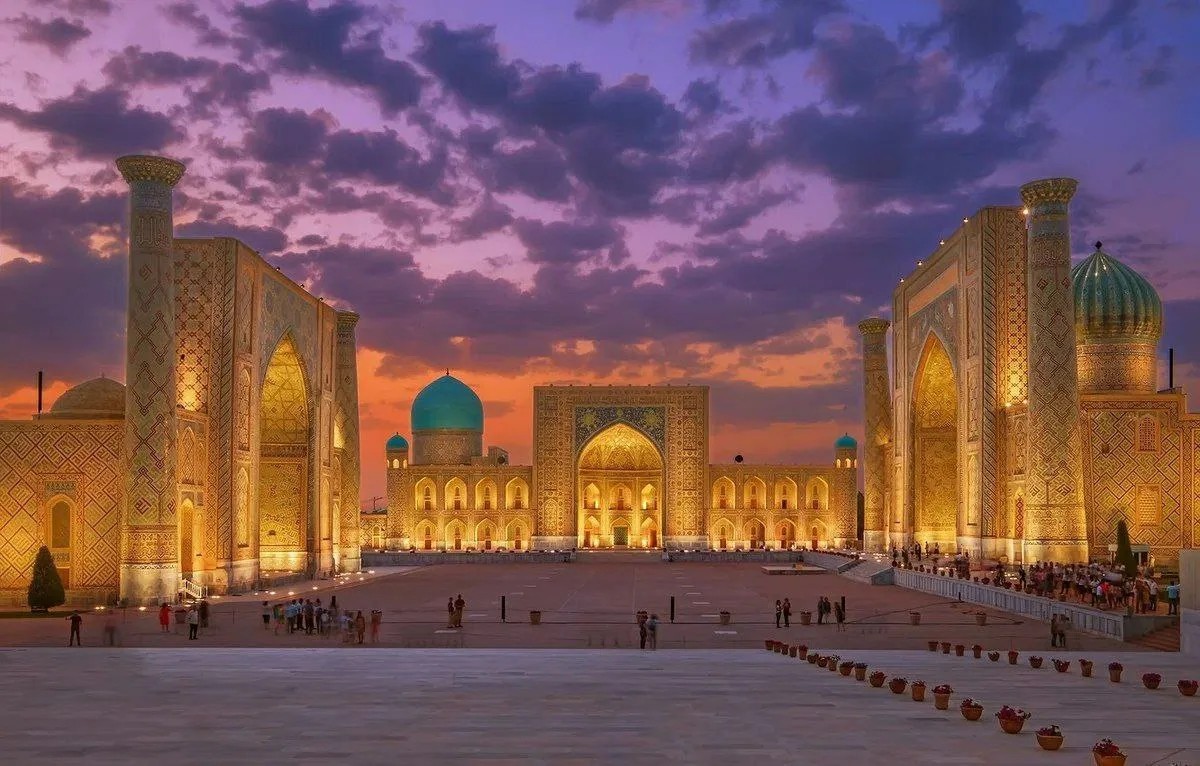
At the heart of the city stands Registan Square, one of the most iconic urban spaces in the Islamic world. Surrounded by three magnificent madrasahs decorated with intricate tilework, calligraphy, and soaring portals, the square expresses the grandeur of Samarkand more than any single monument. It is not only visually breathtaking but historically important as a place where education, ceremony, and public life came together.
Other major landmarks deepen the experience. Shah-i-Zinda is a sacred necropolis whose dazzling mosaics and layered tombs create one of the most memorable architectural walks in Uzbekistan. Gur-e-Amir, the mausoleum of Amir Timur, reveals the refinement of Timurid design. The Ulugh Beg Observatory reminds visitors that Samarkand was also a center of scientific thought, where astronomy and mathematics flourished at a remarkably advanced level.
Samarkand is not only about monumental history. The city continues to live through local traditions, crafts, markets, music, and cuisine. Visitors can experience Uzbek hospitality in courtyards and family-run guesthouses, taste regional specialties, and observe how ancient heritage coexists with modern tourism and urban life. The atmosphere feels ceremonial yet warm, and many travelers find that Samarkand captures their imagination more deeply than any photograph can.
Why visit Samarkand? Because it offers one of the clearest windows into the historical power, artistic sophistication, and cultural richness of the Silk Road. It is a destination where history does not feel distant: it rises in domes, echoes in courtyards, and remains visible in the life of the city today.
Best time to visit
Spring and autumn bring the most pleasant temperatures for sightseeing, walking, and spending long hours outdoors.
Travel tips
- Wear comfortable shoes because many attractions require extended walking on stone or uneven surfaces.
- Arrive early at the most famous monuments to avoid peak crowds and midday heat.
- Dress respectfully when visiting religious and memorial sites.
Top attractions
- Registan Square
- Shah-i-Zinda
- Gur-e-Amir Mausoleum
- Ulugh Beg Observatory
Things to do
- Visit major monuments early in the day to enjoy softer light and fewer crowds.
- Explore local workshops and markets to see paper making, ceramics, textiles, and souvenirs.
- Try regional cuisine and traditional sweets after a day of sightseeing around the old city.
- Spend time in the evening around Registan to experience the square in a different atmosphere.