
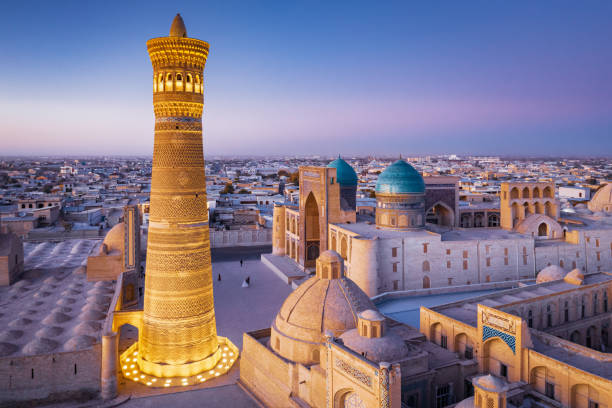
Bukhara
A deeply atmospheric Silk Road city where living traditions, Islamic scholarship, and preserved old streets shape every step.
About the city
Bukhara is one of the most atmospheric cities in Uzbekistan and one of the most authentic places on the Silk Road. Its historic center preserves the feeling of a true trading city, where narrow streets, mudbrick walls, domed structures, and monumental religious buildings create a setting that feels remarkably intact. Walking through Bukhara often feels less like visiting isolated monuments and more like entering a complete historical environment.
For centuries Bukhara was known as a major center of Islamic scholarship, spirituality, and intellectual life. Scholars, theologians, merchants, and craftsmen passed through the city, helping it grow into one of the most respected cultural centers in the region. Its importance can still be felt in the many mosques, madrasahs, libraries, and courtyard spaces that remain woven into the urban fabric.
The city is rich in architectural highlights. The Poi Kalyan Complex stands as one of the defining landmarks of Bukhara, with its famous minaret rising above the old city skyline. The Ark Fortress speaks of royal authority, political history, and centuries of change. Around Lyabi-Hauz, visitors find one of the most relaxed and charming parts of the city, where pools, trees, old buildings, and tea houses come together in a beautifully human-scale setting.
Bukhara also offers a distinctive cultural experience because traditional crafts remain visible and meaningful. Embroidery, metalwork, miniature art, carpet weaving, and wood carving continue to shape the identity of the city. In its trading domes and artisan workshops, travelers can still witness skilled workmanship rather than only staged souvenirs. This gives Bukhara a lived-in, authentic character that many visitors find deeply memorable.
Food is another important part of the experience. Bukhara's cuisine reflects the city's history as a crossroads of communities and tastes. Meals often feel slower and more intimate here, whether enjoyed in a historic courtyard, a family guesthouse, or a traditional tea house. Along with classic Uzbek dishes, travelers can discover regional variations and the pleasure of taking time over tea, sweets, and conversation.
Why visit Bukhara? Because it offers a rare sense of continuity between past and present. History here is not reduced to a backdrop; it remains tied to craft, faith, hospitality, and daily life. For travelers who want depth, atmosphere, and cultural texture rather than only photographs of monuments, Bukhara is one of the most rewarding destinations in Uzbekistan.
Best time to visit
Spring and autumn are the most comfortable seasons for walking through the historic center and visiting monuments.
Travel tips
- Take your time and explore slowly because Bukhara rewards unhurried travel.
- Visit local workshops and small markets, not only the major monuments.
- Stay in a traditional guesthouse to experience the city's hospitality more personally.
Top attractions
- Poi Kalyan Complex
- Ark Fortress
- Lyabi-Hauz
- Trading Domes
Things to do
- Explore artisan workshops to see embroidery, metalwork, ceramics, and other traditional crafts.
- Take slow walks through the old city to absorb the atmosphere rather than rushing between monuments.
- Enjoy tea or dinner in historic courtyards and roof terraces overlooking the old skyline.
- Spend time around Lyabi-Hauz, where local life and the historic environment meet most naturally.